
If you are planning to buy a plot, villa or apartment in Coimbatore, you may have seen the terms DTCP approval and RERA registration used together. Although both are important in real estate, they do not mean the same thing. Understanding the difference between DTCP and RERA can help buyers evaluate a property more carefully before paying an advance or signing an agreement.
In simple terms, DTCP approval is primarily related to planning and layout approval, while RERA registration is related to regulating eligible real estate projects and improving transparency between promoters and buyers. The two serve different purposes, and in some developments a project may have both.
What Is DTCP Approval?
DTCP stands for the Directorate of Town and Country Planning. The planning authority has responsibilities that include preparing development plans and approving layouts and building plans.
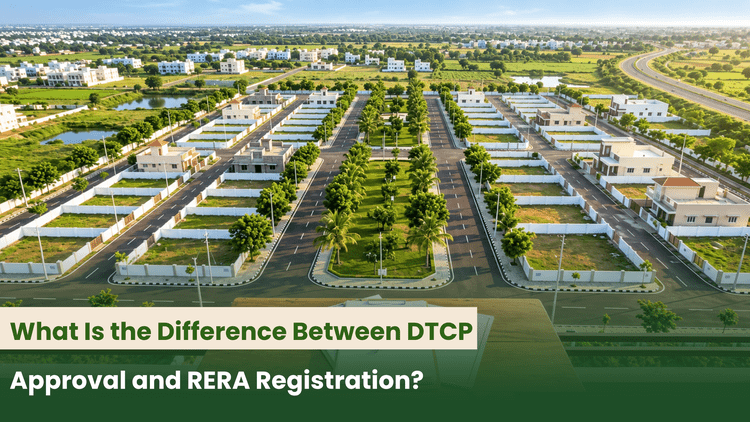
When buyers look for a DTCP approved property in Coimbatore, they are generally looking for a development whose layout has received the applicable planning approval. For plotted developments, this is particularly important because the approved layout determines how the land is divided and how elements such as roads and open spaces are planned.
A DTCP approval should not be viewed as a general guarantee of every aspect of a property transaction. Buyers still need to verify title, ownership, encumbrance records, sale documents and other legal requirements independently.
What Is RERA Registration?
RERA refers to the Real Estate (Regulation and Development) Act, 2016. In Tamil Nadu, eligible real estate projects are regulated through the Tamil Nadu Real Estate Regulatory Authority.
RERA focuses on transparency, project disclosures, promoter responsibilities and buyer protections. Covered projects generally need to be registered before they are advertised, marketed, booked or sold.
For buyers, RERA registration can provide access to important project information, including details about the promoter, project, sanctioned plans, completion timelines and other disclosures.
Therefore, when comparing the difference between DTCP and RERA, remember that RERA is not simply another type of layout approval. It is a regulatory framework for eligible real estate projects.
DTCP Approval vs RERA Registration: What Is the Main Difference?
The easiest way to understand the difference between DTCP and RERA is to consider the question each one addresses.
DTCP asks: Has the layout or development been approved according to applicable planning regulations?
RERA asks: Is the eligible real estate project registered with the regulatory authority and providing the required disclosures and protections?
DTCP is therefore primarily connected with planning and development permission, while RERA is focused on project regulation, transparency and promoter accountability.
This distinction is particularly important when comparing DTCP approved properties in Coimbatore. A buyer should not assume that the words “DTCP approved” automatically mean that every RERA requirement has been satisfied. Similarly, RERA registration should not be treated as a replacement for checking planning approvals and property documents.
Do DTCP and RERA Apply to the Same Properties?
The applicable requirements depend on the type, size, location and nature of the development. A small individual resale plot may not be treated in the same way as a large developer-led plotted project, apartment development or villa community.
Some organised plotted developments can carry both DTCP approval and RERA registration. This provides buyers with two different layers of information: planning approval for the development and regulatory information relating to the eligible project.
Why Is DTCP Approval Important When Buying a Plot?
For buyers searching for DTCP approved property in Coimbatore, checking the layout approval is an important part of the due-diligence process.
An approved layout provides information about the sanctioned development arrangement, including the approved plot configuration and planned infrastructure. Buyers should compare the actual property with the approved layout rather than relying only on advertisements or verbal statements.
Before purchasing, ask the developer or seller for the relevant approval details and documents. The approval number should be independently verified through the appropriate planning authority or with assistance from a qualified property lawyer.
Why Is RERA Registration Important?
RERA registration can be particularly relevant when purchasing from a developer in an eligible project.
The framework provides buyers with access to project-related information and establishes responsibilities for promoters. RERA also provides mechanisms through which eligible buyers can raise grievances and seek remedies in applicable situations.
For example, official RERA-related guidance recognises buyer rights to obtain information about sanctioned plans, project schedules and amenities. It also provides remedies in certain circumstances where possession obligations are not fulfilled according to the applicable agreement.
This makes RERA registration an important factor when comparing new apartments, villas and larger plotted developments.
Is a RERA-Registered Property Automatically DTCP Approved?
No. Buyers should not assume that one automatically replaces the other.
DTCP and RERA address different areas of property development. A project may need applicable planning permissions as well as RERA registration depending on the development and regulatory requirements.
Therefore, buyers should ask for both sets of details where applicable.
If a developer says a project is “DTCP and RERA approved,” request the specific DTCP approval information and RERA registration number. Then verify both independently before making a substantial payment.
How Can You Verify a DTCP Approved Property in Coimbatore?
If you are searching for a DTCP approved property in Coimbatore, use a document-first approach.
First, ask for the approved layout plan and approval number. Check whether the project details correspond with the property being offered.
Second, review the ownership and title documents. DTCP approval does not replace title verification.
Third, check the encumbrance certificate and other relevant land records.
Fourth, compare the physical site with the approved layout. Confirm the plot number, boundaries, road access and other relevant details.
Finally, have the documents reviewed by an independent property lawyer before registration.
How Can You Verify RERA Registration?
For a project that is required to be registered, ask the promoter for the RERA registration number.
Search the project on the Tamil Nadu RERA system and compare the registered information with the developer’s sales material. Check the promoter name, project name, location, sanctioned information and declared timeline.
Do not rely solely on a screenshot or brochure. The official registration details should match the property you are considering.
What Should Buyers Check Beyond DTCP and RERA?
Even when a property has both approvals, buyers should conduct broader due diligence.
Check the title, parent documents, encumbrance status, land-use details, approved plan, sale agreement, development specifications, infrastructure commitments and total purchase cost.
For apartments and villas, examine the carpet area, common areas, parking arrangements, maintenance charges and possession terms.
For plots, pay particular attention to the approved layout, plot dimensions, road access, drainage, water availability, electricity and registration documentation.
Approvals are important, but they are only one part of a complete property verification process.
How Coimbatore Developers Helps Buyers Compare Approved Properties
Coimbatore Developers presents residential property options across different parts of Coimbatore, including apartments, villas and plotted developments. Its website highlights approval information and project details to help buyers compare properties based on location, configuration, amenities and regulatory status.
For example, the website currently lists DTCP & RERA-approved plotted projects in areas such as Thudiyalur, Manikarampalayam–Idikarai, Kalapatti and Sulur.
This makes approval-focused content particularly relevant to users who are researching property before contacting a developer.
Final Answer: What Is the Difference Between DTCP and RERA?
The difference between DTCP and RERA can be summarised simply:
DTCP approval primarily deals with planning and layout approval, while RERA registration regulates eligible real estate projects and promotes transparency, disclosures and buyer protections.
They are not interchangeable. A buyer looking for DTCP approved property in Coimbatore should verify the planning approval as well as the property’s title and legal documents. If the project falls under RERA requirements, the buyer should also verify its RERA registration and project information.
For greater confidence, never make a property decision based only on the words “DTCP approved” or “RERA registered.” Verify the actual documents, compare the approved information with the property, understand the agreement and obtain independent legal advice when necessary.
For buyers exploring approved apartments, villas and plots in Coimbatore, Coimbatore Developers provides a range of projects where approval and project information can be compared before taking the next step.


